Some ideas live quietly in your work for years before you find the words to describe them.
Some ideas live quietly in your work for years before you find the words to describe them.
Some ideas live quietly in your work for years before you find the words to describe them.
For a long time, I struggled to explain the operational ecosystems I was observing in complex healthcare environments. Colleagues could often sense that something important was there — that coordination challenges were not simply about workload or individual performance — but I sometimes lost the words to explain the structure behind it.
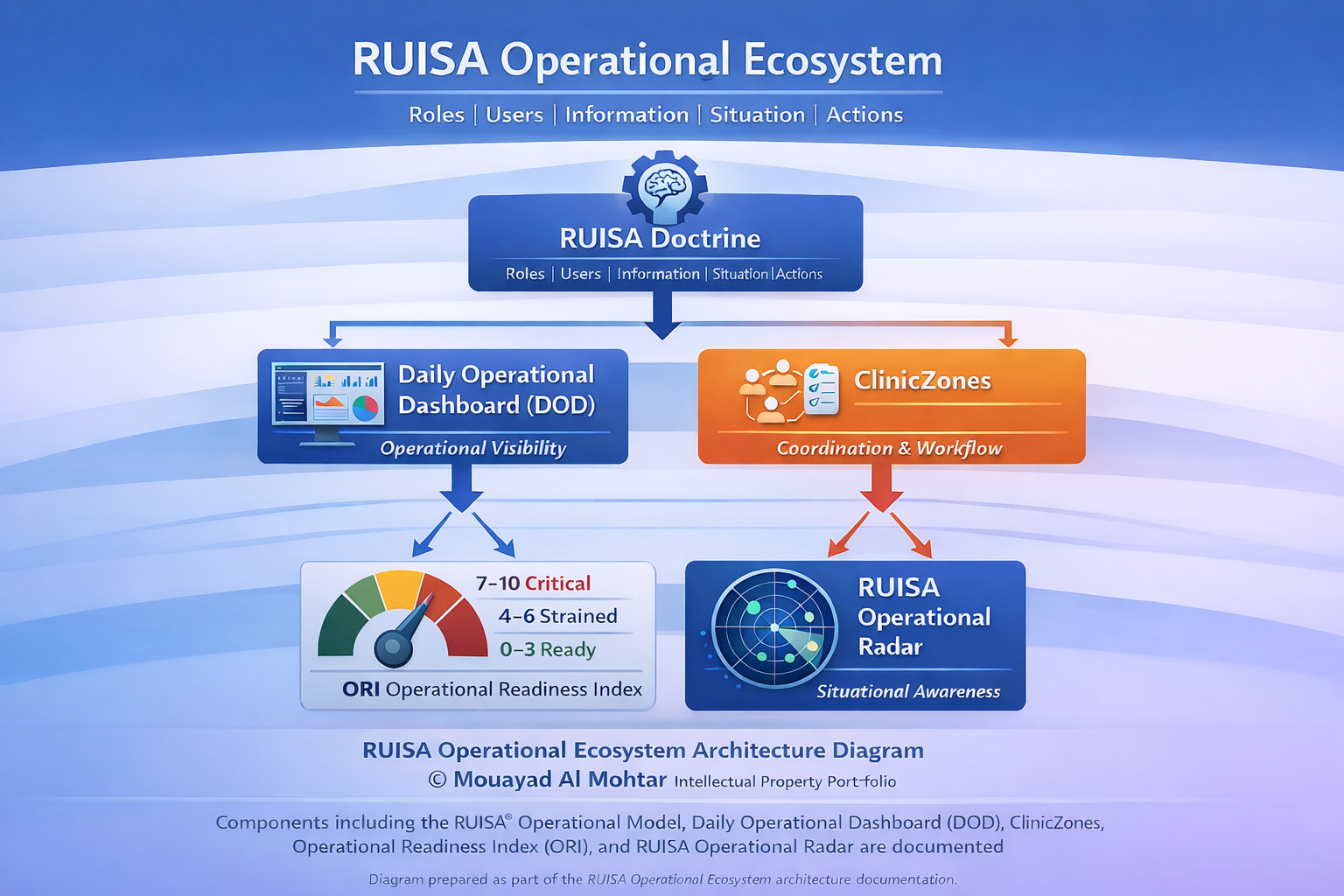
Over time, I realized that many of the pressures people experience in complex operations come from misalignment between a few fundamental elements: roles, users, information, situation, and actions. This way of thinking gradually formed a framework I developed and documented as RUISA — a Universal Operational Coherence Framework for Sociotechnical Systems. The framework itself did not begin as theory. It emerged from practical attempts to reduce operational bottlenecks, improve coordination, and create environments where teams working under pressure can actually breathe.
I recently documented this thinking in a conceptual paper introducing RUISA, which is now publicly available with a DOI: https://doi.org/10.5281/zenodo.18968925
The framework reflects years of observing and structuring operational coordination, and it continues to evolve alongside practical tools developed in the field, including the Daily Operational Dashboard (DOD), the ClinicZones coordination model, and the Operational Readiness Index (ORI).
For me, this moment is less about publication and more about recognizing a long journey of trying to understand how complex systems can achieve operational coherence.
The work continues.
#SystemsThinking #HealthcareOperations #SociotechnicalSystems #OperationalLeadership #RUISA
Related content
Continue through the RUISA writing system
Nurses as Operational Shock Absorbers: A RUISA®-Based Conceptual Analysis of Hidden Instability in Healthcare Systems
Nurses as Operational Shock Absorbers: A RUISA®-Based Conceptual Analysis of Hidden Instability in Healthcare Systems
The Leader Closest to the Pressure Sees the Problem’s True Shape
The Leader Closest to the Pressure Sees the Problem’s True Shape
Imitation Without Understanding: Why Copying Operational Solutions Produces Failure
Imitation Without Understanding: Why Copying Operational Solutions Produces Failure