Roles
Authority boundaries, accountability, decision rights, and expected outputs.
Formal doctrine
The intellectual core of RUISA: a doctrine for aligning roles, users, information, situation, and actions so complex operations remain coherent under pressure, while standing in conversation with systems thinking, high reliability organization theory, Reason's Swiss Cheese model, and Normal Accident Theory.
Framework identity
The model is technology-agnostic and built to preserve operational coherence across real environments rather than idealized process diagrams.
Reading path
Entry point
A compressed reading path for leaders who need the model, its purpose, and the operational value quickly.
Read the briefEntry point
A full reading path for the doctrine, structure, applications, and implementation logic behind the system.
Explore the frameworkBuilt for complex operational environments, leadership judgment, and operational clarity.
Beyond healthcare
RUISA was developed in healthcare operations. Because it is about how responsibility, information, situation, and action stay connected under pressure, the same logic may be discussed in aviation, emergency response, AI oversight, and municipal operations. Those uses are possibilities to be tested, not established applications. The testable form of the model is set out on the coherence model page.
Core artifact
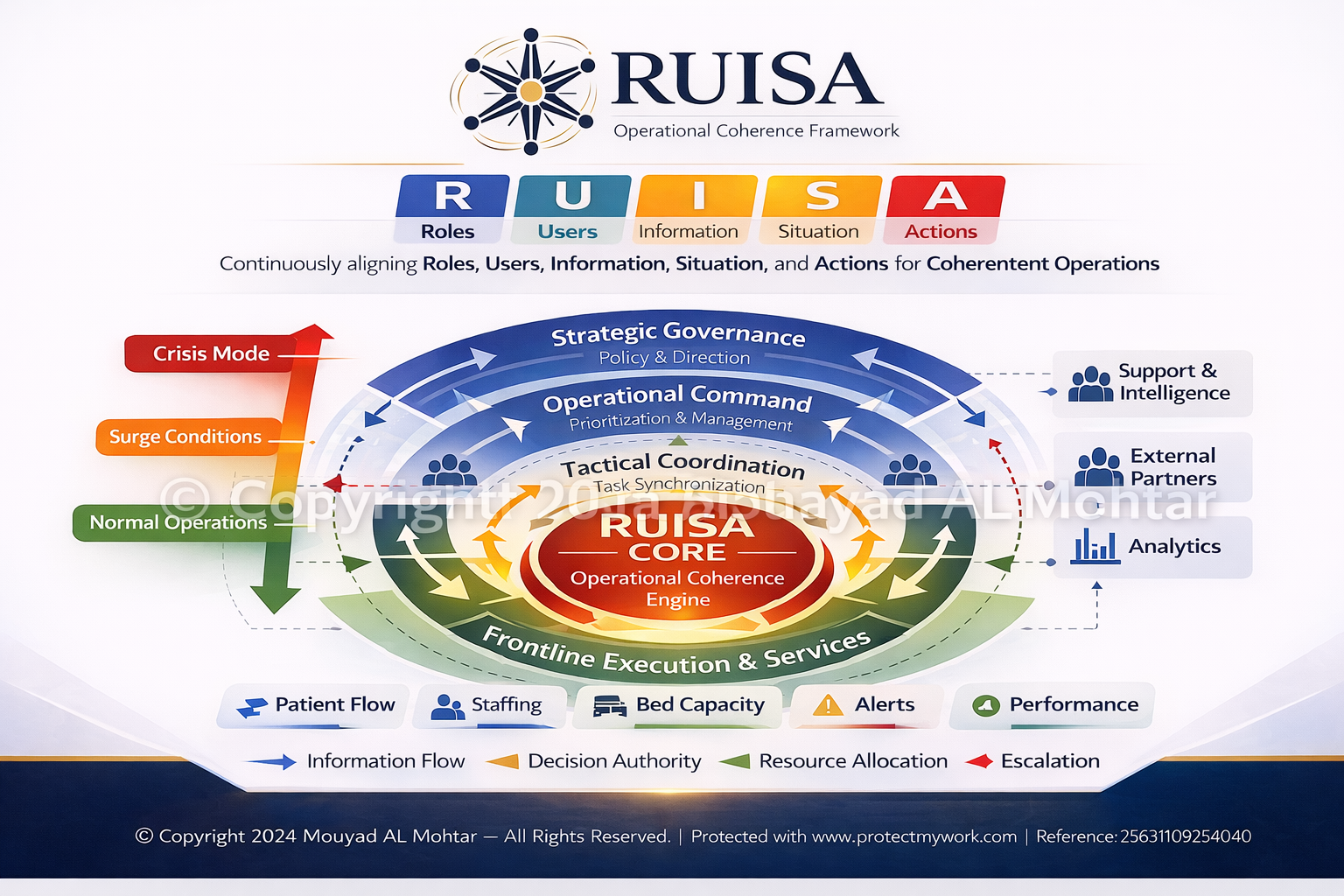
The RUISA structure presented as a core doctrine artifact rather than a decorative image.
Core pillars
Each element is treated as a doctrine panel inside the larger operational architecture.
Roles
Authority boundaries, accountability, decision rights, and expected outputs.
Users
Capability, availability, workload, and substitution readiness in real operating conditions.
Information
Accurate, timely, accessible signals that support coordinated action.
Situation
The true operational context, including demands, risks, uncertainty, and opportunities.
Actions
The decisions and tasks that turn intent into measurable outcomes.
Doctrine panel
RUISA is an operational coherence framework for coordinating complex activities by keeping roles, users, information, situation, and actions connected. Its testable form, the RUISA coherence model, asks where and for how long that chain becomes disconnected under pressure.
It offers a structured way to examine how work is organized, understood, and executed in real time, so units can be read as connected systems rather than fragmented parts.
Coherent outcomes arise when responsibility, capability, shared understanding, context, and response remain synchronized.
Doctrine panel
RUISA does not propose a new theory of workload, patient flow, resilience, or coordination. Its contribution is a method for locating which operational relationship has separated, and how long the separation persists.
It addresses a recurrent failure mode in complex environments: misalignment between what must be done, who must do it, what is known, what is happening, and what response is taken.
The framework sits in conversation with Relational Coordination, resilience engineering and FRAM, situation awareness research, High Reliability Organization theory, and Reason's Swiss Cheese model. It does not claim equivalence; it offers a distinct lens on operational coherence.
Doctrine panel
RUISA has been developed and applied in hospital nursing operations. Its coherence logic may extend to other settings with multiple actors, dynamic conditions, and time-sensitive decisions, but those applications remain to be tested.
Doctrine panel
Effective operations require continuous alignment of all five elements.
Right roles, capable users, accurate information, true situational context, and appropriate actions together produce coherent performance.
Misalignment produces degradation: confusion, duplicated effort, delayed decisions, or failure to respond.
Doctrine panel
Structured flows of information, authority, resources, and escalation connect these layers.
Doctrine panel
The structure remains stable while behavior adapts to circumstances.
RUISA does not replace existing systems. It provides a coordination doctrine that can operate across them.
Doctrine panel
RUISA should be maintained as a coherent framework. Implementations may adapt to local context without losing the alignment of the five elements.
The model does not guarantee success by itself. It creates the conditions under which effective action becomes possible.
Its objective is coherent action under complexity, reliable performance under pressure, efficient use of human and material resources, and operational continuity over time.